Archaeology Museum and Hunting Museum
museum
Open today
10:00 – 18:00
History
When the dukes moved to the Ducal Palace, in the early sixteenth century, this castle could have died. Instead, it became what it is today: the attic of Vila Viçosa's memory. Inside the citadel where the Braganza family lived its first centuries, two museums now operate, and each answers a different question. The Archaeology Museum asks: who was here before us? The Hunting Museum: how did those who were here live?
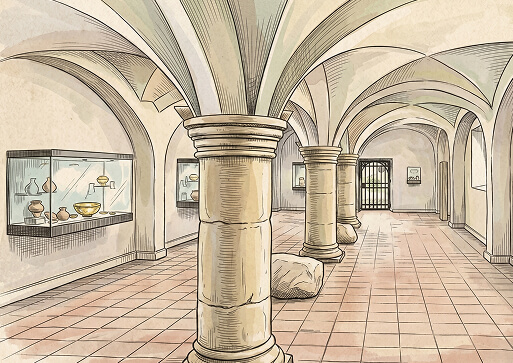
The first museum's answer begins in the most improbable way. Much of this collection was not excavated by university professors: it was gathered by António Dias de Deus and Luís Agostinho, two employees of the Vila Fernando Penal Colony who, in the hours they had free, excavated archaeological sites all across the Alto Alentejo. The volume and quality of their finds were such that they attracted a renowned archaeologist, Abel Viana, who studied the pieces and founded this museum. Walk through the rooms and do the maths on time itself: from the Palaeolithic to the eighteenth century, with particular richness in the Roman period, excavated in this very town. And then come the surprises: pieces from Egypt, from Carthage, and even pre-Columbian artefacts, some of them from the personal collections of a collector king, Luís I. A journey through the ancient Mediterranean and the wider world, inside a medieval Alentejo castle.
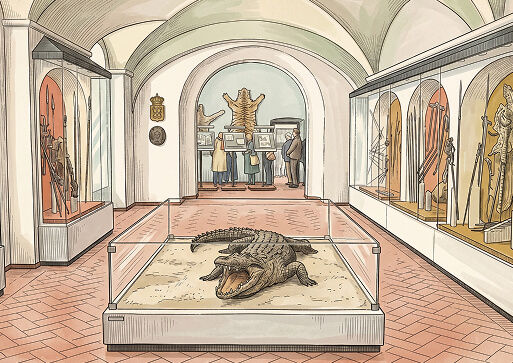
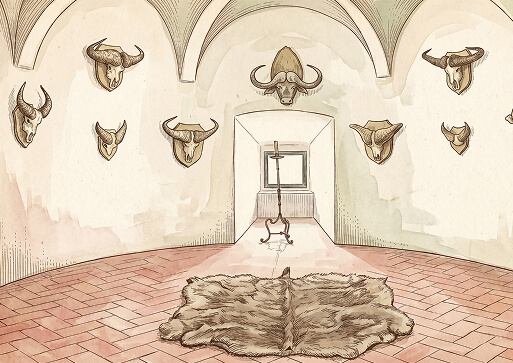
The second museum tells of this house's great passion: the hunt. The Braganzas turned their game reserve into the largest walled natural space in the country, eighteen kilometres of wall enclosing a world of deer and wild boar, and generations of dukes and kings came to Vila Viçosa above all for this. The rooms display that obsession on a grand scale: European birds, African and Asian trophies, the skull of a pygmy elephant, and a collection of two hundred weapons.
But there is one section here that deserves a moment of silence. In 1907, the crown prince, Luís Filipe, made a grand voyage to the African colonies, and from the communities he visited he received ceremonial weapons, spears, assegais, pieces of regalia, offered to him and to his father, King Carlos, the most passionate hunter this castle ever knew. The gifts came to swell the family's collections. Months later, on 1 February 1908, father and son were assassinated together, in Lisbon. The African gala weapons remained here: farewell gifts that no one knew were farewells.
Before you leave, climb the walls. From up there you can see the whole town, the houses, the orange trees, the marble everywhere. The medieval watchmen scanned this horizon for enemies; today's visitor scans it for the way to the next monument. The castle, for its part, keeps doing what it has always done: it guards. It no longer guards the border. It guards time.
Curated by Storypath


