Interactive House Museum, Rézio Family
Forty-six clay vats, standing still since 1957. Two granddaughters would not let the memory of their grandparents drain away with them.
Listen to the story
There are grand stories, of kings and battles, and there are small stories which, because they are true and because they are told by those who lived them, end up saying as much as the others. This is one of them.
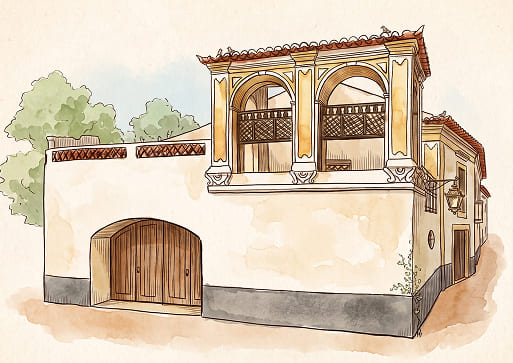
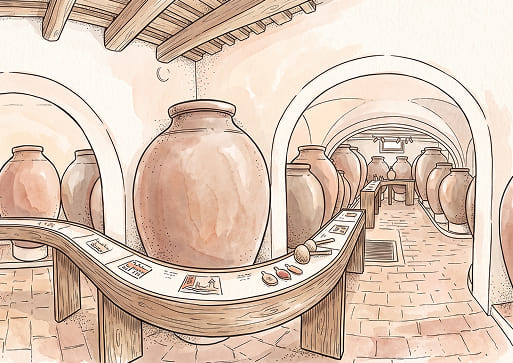
In the heart of Borba, near the Church of Santo António, there is a nineteenth-century house that, from the outside, looks like so many other farmers' houses in the region: ground floor for work, upper floor for living. But on the ground floor of this particular house is something most similar houses have already lost: an entire cellar, intact, with forty-six original clay vats, a vinegar cellar beside it, the courtyard, the old stable, the well. Here, for generations, the Rézio family made wine, vinegar and spirits, as almost every family in Borba did in the days when the town lived, entirely, on the vine.
And the cellar of this house worked far later than one might expect. It only stopped in 1957, the year the newly founded Borba Cooperative Winery began operating and gathering in one place what had once been done, house by house, in dozens of small clay-vat cellars scattered across the town. When the cooperative opened, this house closed. The vats were left empty, but they were left in place. Nobody took them away.
Decades passed. Generations changed, as they always do. And this house could have followed the fate of so many other clay-vat cellars in the town: converted into a warehouse, a garage, a shop, its vats sold or broken, the past erased for being of no use to the present. That is not what happened. Two cousins, Teresa Rézio and Amélia Santos, granddaughters of the family that had lived and worked there, looked at that house frozen in time and decided they would not let it die. They later said that what moved them was simple: to preserve and honour their grandparents' roots.
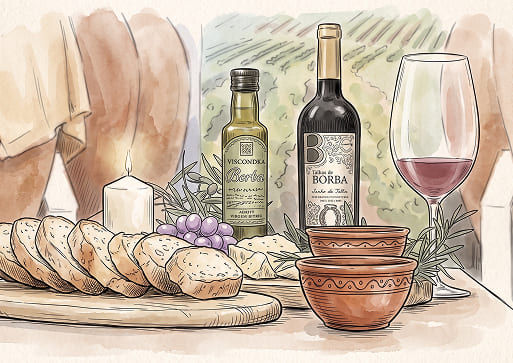
The work was not small. They restored the house, kept the forty-six vats exactly where they had always stood, and turned the space into an Interactive House Museum, opened to the public on 13 June 2021. Those who enter today do not just see objects behind glass: there are interactive displays telling the story of clay-vat wine, and for the youngest, games that teach, through play, a tradition that in Borba goes back two thousand years. At the end of the visit, a courtyard with a terrace and café, where one can still taste the flavours and smells of the region that this house once produced.
It is a small story, with no kings or generals, and that is exactly why it is worth telling. In this town that has lived through wars, fires and a plague that nearly wiped it off the map, this was the gesture that kept it whole: two women who decided that their grandparents' house would not close in on itself, and opened it, instead, to everyone. The vats no longer make wine. But they are still, more than sixty years on, telling exactly the same story.
© 2026 StoryPath.pt — Made in Alentejo