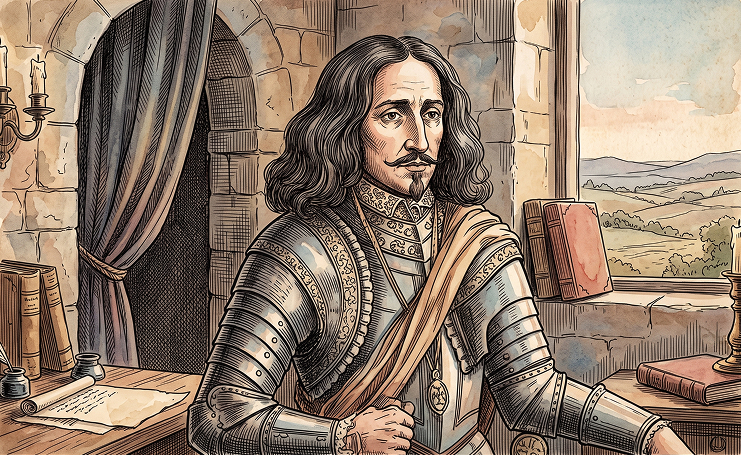
Dinis de Melo e Castro, Count of Galveias
history
History
You are standing in front of the Quinta do General, a house that holds one of the most remarkable coincidences in Portuguese history. It was built by Pedro de Melo e Castro, a nobleman of the House of Braganza from Vila Viçosa, who had fought at Alcácer Quibir. In that battle of 1578, Portugal lost its king, its army and, two years later, its independence. In this same house, in 1624, a descendant of his was born: Dinis. Eighty-seven years after Alcácer Quibir, it was Dinis who led the cavalry in the battle that gave back to Portugal what his ancestor had seen lost. The same family, the same house: one saw the country lost, the other helped win it back.
Dinis was sixteen when, on 1 December 1640, Portugal rose up against Spain. He did not hesitate. He enlisted in one of the first expeditions that King João IV sent to reinforce the Alentejo frontier, and left as a common soldier. He did not know the war would last twenty-eight years, or that it would take up almost his entire adult life. He fought at Montijo in 1644, still without rank. He was taken prisoner by the Spanish at the fort of São Miguel and ransomed near Badajoz. He was at the Lines of Elvas in 1659 and at Ameixial in 1663. In all, he fought in eleven battles and received twenty-two wounds. By the end, his body was a map of the whole war.
He rose by merit, not by birth: from soldier to captain, from captain to field master, from field master to general. In 1662 and 1663 he commanded the army of the Alentejo, the province where everything was decided. In June 1665, something happened that no novelist would dare invent. The last great Spanish army, led by the Marquis of Caracena, marched on Vila Viçosa to destroy the Palace of the Braganzas. The Portuguese went to meet it at Montes Claros, three kilometres from this house. Dinis had spent twenty-five years fighting far from home, and he led the cavalry in the decisive battle of the war within sight of the house where he was born. On 17 June 1665, the Spanish army broke apart on that field. The war was won, and he had won it at home.
He lived another forty-four years. King Pedro II made him Count of Galveias in 1691, and a member of the Councils of State and of War. As an old man, he still fought in the War of the Spanish Succession. He died in 1709, aged eighty-five, the last of the great soldiers of the Restoration. In 1744 a nephew wrote his biography, with an engraved portrait in which his face can still be seen today: a man with a hard gaze, above his coat of arms.
The house still stands. It grew over the centuries and, in the early twentieth century, was enlarged by Raul Lino, the most celebrated Portuguese architect of his time. The avenue on which it stands bears the general’s name. It was from here that a sixteen-year-old boy set out, and it was three kilometres from here that he helped save his country.
Private property. The house can be seen from the avenue.


