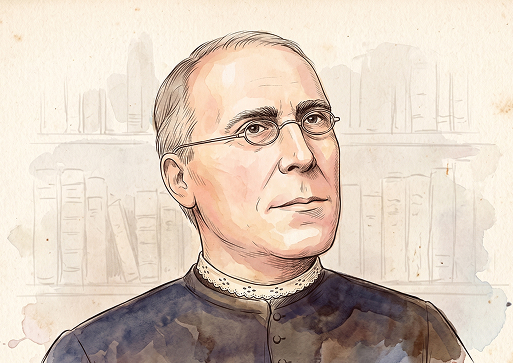
Father Joaquim José da Rocha Espanca
history
History
Every story you have heard on this visit, the dukes and their crimes, the queens and their crowns, the bells, the convents, the names of the streets, has reached us because one man decided it must not be lost. His name was Joaquim José da Rocha Espanca. He was born in Vila Viçosa on 17 May 1839, he was a village priest, and he did alone what no institution had done: he wrote the entire history of his land.
The undertaking was out of all proportion to his means. A poor parish priest, with no income beyond that of his ministry, as he himself wrote, Father Espanca had no books, no archive, no time. What he had was stubbornness. He rose at dawn and walked from Bencatel to Vila Viçosa, returning almost at nightfall, eating nothing more than "some biscuit carried in my pocket", to consult the Municipal Library, which had neither librarian nor catalogue, and the library of the Colégio dos Reis, kept in the Ducal Palace. In Évora, the library opened only two hours on certain days of the week, and he took notes in pencil, "in too much haste". He paid out of his own pocket for certificates from the Torre do Tombo archive. He travelled to Lisbon on purpose. To find the time, he cut back on the only other passion he had: music. He was a composer, and his masses and motets, still kept today in the Library of Évora, he gave up, piece by piece, in order to write history. "This," he said, "is what is called working from the heart."
For decades, between baptisms and burials, he filled five manuscript volumes of nearly a thousand pages each: the Memórias de Vila Viçosa, the chronicle of the town from the Romans to his own day, year by year, council session by council session, stone by stone. His rigour impressed the greatest: Leite de Vasconcelos, the father of Portuguese archaeology, called him an antiquarian, and it is to this priest that we owe the transcription of the Roman altars to Endovelicus. His eyesight, always poor, wore away over the old manuscripts. By the age of forty-one, he could barely read. He carried on.
In his final years, the town called him back: he ended his days as prior of São Bartolomeu, praying in the church of a land he had spent his life writing. He died in 1896, and in his lifetime almost no one paid him any heed. The manuscript slept for nearly a century in the Municipal Library, "in an almost undeserved oblivion", until the town council published it in 1983. But Father Espanca knew it would be so, and he said it in the most moving way possible, in the dedication of his work: he offered it "to my contemporary fellow countrymen without distinction of class, and above all to those yet to come, to whom these memoirs set down here matter most". To those yet to come. He wrote, knowingly, for people who had not yet been born. He wrote for you, who are listening to this now.
The manuscript volumes are still here, kept in this library. Every guide, every historian, every plaque in this town draws from them. Vila Viçosa had those who made it great: dukes, queens, saints and geniuses. And it had one man who would not let anyone forget them.
StoryPath was born, first and foremost, from his notebooks, and it is to him that it pays its most fitting tribute. Father Espanca wrote for those yet to come; we are those who came, and we have received the commission. Our mission is the one he left in writing: that none of these stories be lost, and that they reach everyone, without distinction of class, as he asked. He saved the memory of Vila Viçosa by the light of an oil lamp. We have only lit it another light.
Curated by Storypath


