The Street of the Hanged Men
other
History
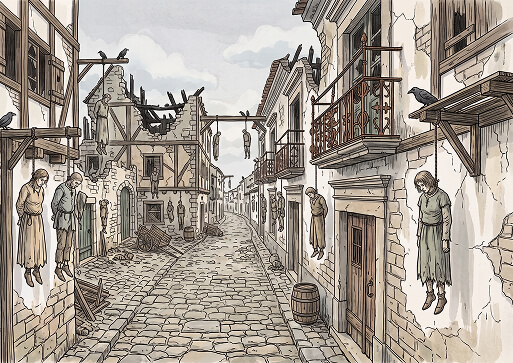
Walk down Rua Direita, in the centre of Borba, and you won't find a single plaque telling you what happened there. But for a long time, this street had another name, and it was a name nobody forgot: Rua dos Enforcados. The Street of the Hanged Men.
It was the summer of 1662. Portugal had already fought twenty-two years of war against Spain for its independence, and that year, Philip IV decided to strike the final blow: he launched three armies against the Alentejo frontier, one of them twenty-two thousand strong, commanded by the Spanish king's own illegitimate son, Don John of Austria. It was that army that laid siege to Borba. The town defended itself with a courage the chroniclers still record today: at the head of the garrison stood the captain-major Rodrigo da Cunha Ferreira, and the people of Borba held out, inflicted losses on the enemy, killed three Spanish captains, a sergeant, twenty soldiers, wounded fifty more. But Borba had no way of resisting an army of that size. The town fell.
And what followed was not the usual surrender of the wars of that time. Don John of Austria did not treat Borba's defenders as soldiers of an enemy army, entitled to the honours of war. He treated them as traitors to his own king — because for Spain, Portugal was still, in its eyes, a rebellious subject. And traitors are hanged. The governor of the castle and two other Portuguese captains were brought to this street, and there they died on the gallows, in full view of the whole town. The people never again called it anything but the Street of the Hanged Men — a name that endured for generations, until it was later softened into today's Rua Direita.
But Don John of Austria wasn't finished. He ordered the town hall and the municipal archive burned to the ground — the record house where Borba had kept, since the charter of King Dinis, centuries of written memory: charters, rulings, contracts, the record of who the town had been. Everything was lost. That is the reason, and the only reason, why so little is known today about this land's earliest centuries: it isn't that nothing was ever written. It's that a Spanish general decided, one afternoon in 1662, that Borba didn't deserve to have had a past.
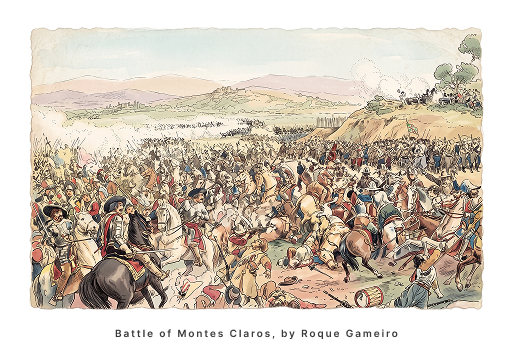
But history, sometimes, has a sense of justice that feels almost literary. Three years later, on the 17th of June 1665, that same Spanish army — the heirs of that vengeance — returned to this territory, this time trying to destroy Vila Viçosa and the Palace of the House of Braganza. They found the Portuguese waiting a few kilometres from here, at Montes Claros, where the Portuguese troops crushed them once and for all. The general who had ordered Borba hanged and its history burned watched his world collapse on the very ground where the vines now grow that give their name to the wine drunk across the whole region.
Next time you raise a glass of Montes Claros, remember that the victory it celebrates owes a debt to this street. Borba paid first, in rope and in fire. Vila Viçosa and the rest of the Alentejo paid it back, three years later, with peace. And this town, which lost its oldest archives in one afternoon of vengeance, found the most Alentejan possible answer to being forgotten: it kept planting vines, kept making wine, and kept existing, century after century, to this day.


