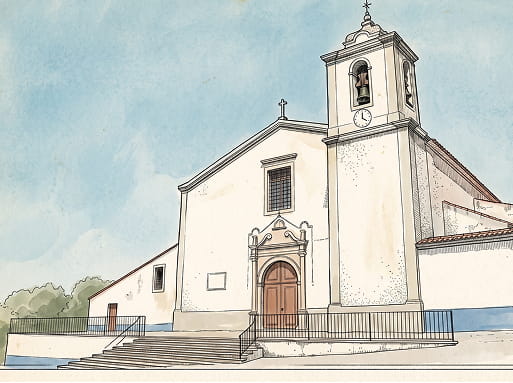
Mother Church of Our Lady of the Soveral
church
History
This church was meant to be the centre of Borba. It never was.
In 1420, the Master of the Order of Avis ordered the new Mother Church to be built here, outside the town. The marble plaque on the right side of the nave still records it: it is the only trace left of the church of that time. The reason for the choice was political. The town was growing hastily along the road to Estremoz, and the Order wanted to pull it towards this side by placing its main church here. But a planning decision moves no one, and so a legend was born: the Virgin was said to have appeared on this spot, in a grove of cork oaks, a soveral, beside the pond where the barbel was found that gave Borba its name. Our Lady of the Soveral.
The legend took hold. The faithful came to be weighed on a great scale set on a stone, and offered the Lady their own weight in wheat. In the chancel, the Virgin was painted seated at the foot of a cork oak, with the Child in her arms and Gothic letters beneath: This is Our Lady of the Soveral.
The town, however, never came. It kept growing the other way, and raised among its houses, without permission, a church of its own: São Bartolomeu. When the Mother Church was rebuilt, around 1560, the work stopped halfway, and in 1587 a priest wrote that it was impossible to say mass here. In 1609, São Bartolomeu became a parish and took almost all the parishioners with it. Things reached the point where the Crown ordered, by decree, the councillors and nobles to serve in this church's brotherhood, because nobody wanted to. And the two brotherhoods were at war for two centuries: in 1819 they were still suing each other in court.
And then there is the fate of the image, the strangest part of all. Around 1690, when the church was lined with tiles, the fresco of the Virgin of the cork oak was covered over. As early as the eighteenth century, there were those who lamented its loss. Only a copy survived, painted on canvas. And do you know where it is? In the Church of São Bartolomeu, the rival, where the community hung it. The Lady who justified this church was saved only in the church that defied it.
Look, finally, at the chancel. It is the barest part of the building. In the 1780s, a great marble altarpiece was designed for it, meant to be the jewel of the house. It was lost in lawsuits and never made. The two statues standing there today came, they too, from São Bartolomeu.
This is the most important church in Borba on paper, and the most forgotten in life. A lesson in stone for those in power: you can move a church, and even give it a miracle. But you cannot move the place a people wants to go.


