Borba Castle
castle
History
There is an irony at the start of this story worth savouring slowly: this castle was not born of a war. It was born of a peace treaty.
In 1297, Portugal and Castile signed, at Alcañices, the agreement that fixed once and for all the border between the two kingdoms, the same line, almost unchanged, that still separates the two countries today. A peace treaty should have brought rest. Instead, it brought a new problem: now that the border was drawn on paper, it had to be drawn on the ground too, with stone and vigilance. Five years later, in 1302, King Dinis dealt with it in his own way: he granted Borba a charter, making it a council in its own right, separate from Estremoz, and immediately ordered it fortified. Thus was born a link in a chain of frontier castles, Estremoz, Borba, Vila Viçosa, whose mission was simple to state and enormous to fulfil: see the enemy coming from afar, and hold out until help arrived. In the event of invasion, Borba was the last line of defence before Estremoz and before Vila Viçosa itself.
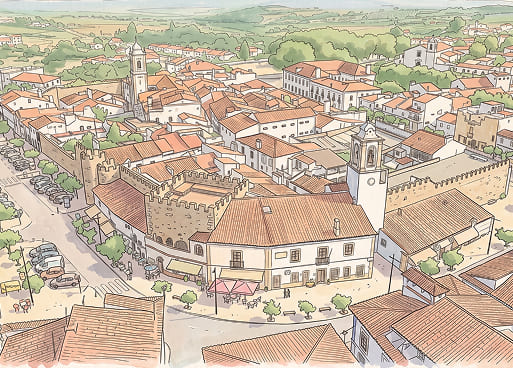
The castle King Dinis had built was solid and without luxury: a square plan, thick masonry walls crowned with Gothic battlements, and a wide rampart walk along which the watchmen paced night and day. It had a moat, now vanished, swallowed by the houses that grew up against the wall over the centuries. The town, quite literally, grew leaning on the back of the castle that protected it.
For a long time, there is almost no record of what happened here. And there is a sad reason for that silence: when Don John of Austria took the castle in 1662, he ordered the entire municipal archive burned, wiping out centuries of written memory. It was also during that invasion that the town lived through its darkest episode, that of the captains hanged in the street that still keeps the memory today. But history, at times, gives back what it steals: three years later, in 1665, it was right here, at Montes Claros, that the Spanish army was finally destroyed. The border this castle had been born to watch was defended, once and for all, a few steps from its own walls.
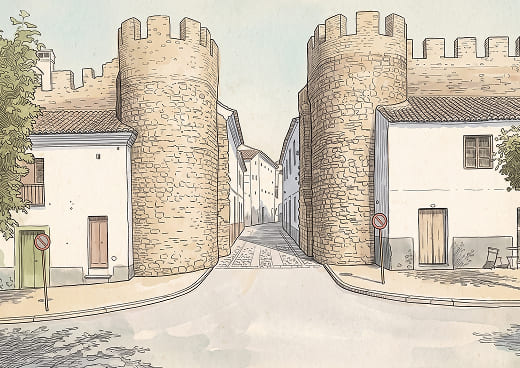
Of the original castle there remain today a stretch of wall, the keep, and two gates, each with a story of its own. One was called the Elvas Gate, because it faced that city. Only in the eighteenth century did it come to be known as the Granary Gate, because the town's common granary was set up there, the storehouse where everyone's grain was kept. The other, facing inland, is the Estremoz Gate. On a southern section of the wall, a simple stone plaque still attests, without grand words, that it was King Dinis who ordered this work and directed its construction.
Today, the castle no longer watches for any enemy. Its walls blend into the houses that grew up beside them, and its ramparts, where sentries once walked, now hold only silence. But pause a moment before this stone and consider this: the border that the signing of a treaty drew in 1297, and that this castle was built to watch over, is, with minor adjustments, the same line that today separates Portugal from Spain. Few monuments in Portugal can say that the reason for their existence still stands, seven centuries later, in exactly the same place.
Curated by Storypath


