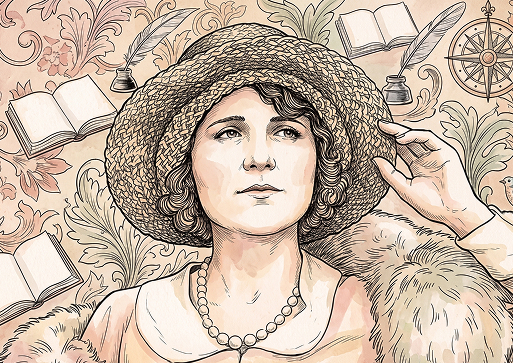
Florbela Espanca (1894–1930)
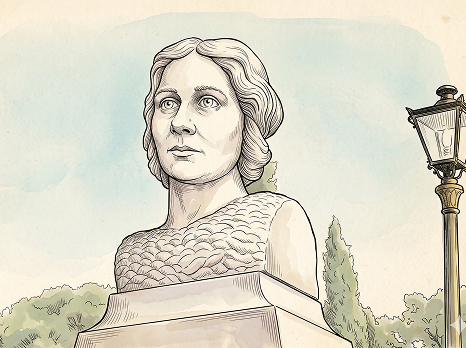
statue
History
A flower born in Vila Viçosa
Flor Bela d'Alma da Conceição was born on December 8, 1894, in a house in the historic center of Vila Viçosa that no longer exists, having been demolished during the public works promoted by the Estado Novo in the 1940s. Currently, there is a memorial marking the site. The daughter of a peasant woman, Antónia da Conceição Lobo, and João Maria Espanca, a photographer, painter, and man of various arts, who was married to Mariana do Carmo Toscano, who could not have children, Florbela and her brother Apeles were registered as children of an unknown father. Curiously, the father would only officially recognize his paternity in 1949, nineteen years after the poet's death.
This origin marked her deeply. She grew up in a house where she was raised simultaneously by her biological mother and her stepmother, an unusual family arrangement for the deep Alentejo of the late 19th century. At the age of eight, she was already writing her first poem, "Life and Death" (A Vida e a Morte), a title that, over time, would prove almost prophetic.
The pioneer
She was one of the first women in Portugal to attend secondary school at a male lyceum, André de Gouveia, in Évora. Years later, she enrolled at the Faculty of Law of the University of Lisbon, where she was one of only fourteen women among about three hundred and forty students. In a patriarchal society, where women were educated for domestic silence, Florbela chose study, writing, and her own voice.
Three marriages, three ruptures
Her love life was as intense as it was troubled. She married three times: first to Alberto Moutinho, a schoolmate, in 1913; then to António Guimarães, an artillery ensign, in 1922; and finally to the doctor Mário Lage, in 1925. Between marriages, she suffered several miscarriages that marked her physically and psychologically — she never became a mother, a pain that runs through all her work. The divorces, in a conservative and Catholic Portugal, exposed her to strong social prejudice.
Poetry as salvation and condemnation
Florbela's body of work is brief but devastating. During her lifetime, she published only two books: Livro de Mágoas (Book of Sorrows, 1919) and Livro de Sóror Saudade (Book of Sister Saudade, 1923). Her masterpiece, Charneca em Flor (Heath in Bloom), would be published posthumously in January 1931. She was not part of any literary movement, but her style evokes romantic poetry, with a strong emotional content. Her sonnets — a form she mastered like few others — speak of love, desire, loneliness, longing, and death with an erotic and feminine frankness unprecedented in Portuguese literature of the time.
The Larousse Encyclopedia classifies her as a Parnassian, of intense female erotic accent, unprecedented in Portuguese Literature, considering that her work anticipates the literary emancipation of women in her environment.
The fall
The death of her brother Apeles in 1927, in an airplane crash, was a blow from which she never recovered. In his honor, she wrote As Máscaras do Destino (The Masks of Destiny). Her mental illness worsened, she was diagnosed with pulmonary edema, and her will to live faded away.
Florbela died by suicide on December 8, 1930, on her 36th birthday, from an overdose of barbiturates. She was buried in Matosinhos, far from the land where she was born.
The legacy
Fernando Pessoa would later call her his "twin soul". Her verses were sung by the band Trovante in "Perdidamente", set to music from the sonnet "Ser poeta" (To be a poet), and continue to be read, memorized, and recited generations later. In Vila Viçosa, a statue honors her in the public space — although the house where she lived remains in a state of ruin, with one of her poems painted on a wall for those who pass by and know how to look.
Florbela Espanca is today, alongside Sophia de Mello Breyner, Natália Correia, and Maria Teresa Horta, one of the founding female voices of Portuguese poetic modernity. But perhaps no other has managed to say with such clarity what she wrote in "Ser Poeta": "It is having the splendor of a thousand desires / And not even knowing what one desires!" ("É ter de mil desejos o esplendor / E não saber sequer que se deseja!")
Curated by Storypath


