The Night the Patroness Lost Her Home
other
History
It was Saturday, 1 November 1755, All Saints' Day. The Matriz was as full as it rarely was all year: people who had just confessed, people waiting to confess, the Patroness's sung mass unfolding as it had every Saturday, for generations. No one could have imagined that, hundreds of kilometres away, Lisbon was falling.
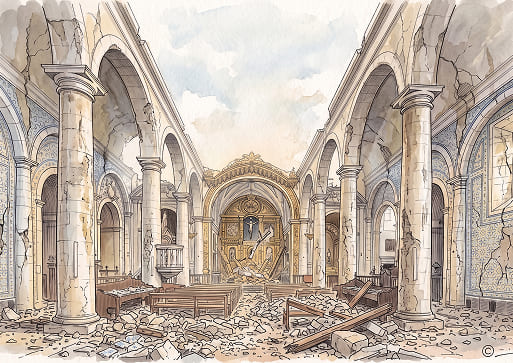
It was shortly past nine in the morning when the earth shook. The vaults swayed. And the one over the central nave — weakened for ninety years, ever since Spanish general Caracena's cannons had battered it during the siege of 1665 — began to give way. First small pieces fell. People tried to leave. And it was then that the very air of the church, pushed by the pressure of the collapse, slammed the doors shut on the crowd.
What followed, Espanca reconstructs with a detail that still chills today: people crushed against the closed doors, in tears and screams, trying to break them down with their own bodies. Torn clothes. Gold necklaces and earrings ripped off in the panic of those trampling each other to flee. The priests, with no time for anything else, fled behind the altar, taking refuge by the very chamber of the Patroness, and abandoned the mass halfway through. Outside, men grabbed whoever managed to reach the doors and pulled them out into the churchyard, away from whatever else might fall.
When the dust settled, the dead had to be counted. Hoes were brought to dig out those buried beneath the rubble, in the hope of finding them still alive. The wounded were anointed right there, in the churchyard, by the prior of the Augustinians who had rushed over with the oil from his convent. Twenty-nine women died inside the church that morning, and two more afterwards, from their injuries. And the survivors, in the midst of the horror, found in it a sign: had the vault fallen all at once, instead of in pieces, no one would have escaped. They called it a miracle worked by the very Lady venerated within.
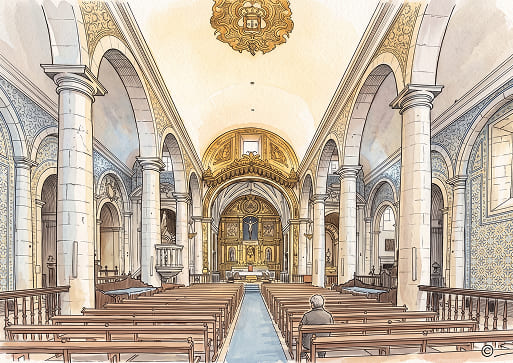
But the tragedy was not yet over. The Matriz was so badly damaged that the Patroness of Portugal, the image for whom a king had abdicated his crown a hundred and nine years earlier, had to leave her home. She was carried, in solemn procession and amid tears, to the Royal Chapel next door. The people of the Castle, Espanca writes, felt orphaned. King José I promised she would return as soon as her church was rebuilt.
And here the story takes its second, bitterer chapter. The prior asked the State for help. He asked the Order of Avis, canonical patron of the temple, which collected tithes precisely for that obligation. Not a single coin came from either side. The reconstruction of the house of the Queen of Portugal was paid for, year after year, from the alms of the faithful and the meagre resources of the parish itself — the people rebuilding, alone, what the earthquake and the indifference of power had brought down twice.
When the new vault was finally closed, the prior made a gesture of gratitude: he had the coat of arms of the Order of Avis painted in fresco on the ceiling, to remember who was, at least on paper, the patron of the temple. Word of this soon reached the all-powerful Marquis of Pombal, who had not spent a single real of the State's coffers, nor of the House of Braganza's, on this work. He immediately ordered the Avis coat of arms scraped from the ceiling and replaced with the Royal Arms — the very ones still seen today on entering the Matriz. He did not pay for the reconstruction. He did not, however, allow anyone else to take the credit for it.
Next time you enter the Matriz and look up at the coat of arms painted on the nave's ceiling, know what you are looking at: it is not the story of who built this church. It is the story of who, without paying a thing, knew how to erase the memory of those who paid for everything.


