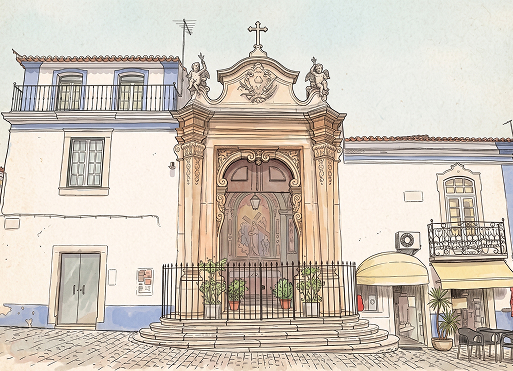
Stations of the Lord, Alto da Praça
church
History
Before it was a Station of the Lord, this place was already a small church with an unusual mission. In 1722, the Chapel of Our Lady of Nazareth was raised here for a single purpose: so that the town's prisoners, locked in the Castle tower next door, could attend mass without leaving their cells. A chapel designed for those who could not enter it. It still keeps, inside, a small window through which the altar could be seen from the neighbouring house.
Thirty years later, in 1755, the town decided to transform it. It was the year of the great earthquake. A few kilometres from here, in Vila Viçosa, the vault of the Matriz collapsed onto a full church and killed twenty-nine women. Borba suffered nothing at all. And some believe the town's four monumental Stations were born of precisely that: an entire town giving thanks for having been spared, and doing so in the most Borba way possible, in marble from the region.
This one, at the Alto da Praça, was paid for by a Captain of Horse, António Duarte Franco, and his wife, Isabel Franca. The captain never saw it finished. In his will, a year later, he still calls it "the little Chapel of the Lord of the Stations," admits it is not yet ready, and orders his son to complete it. He leaves him a third of everything he owns, on one condition: that a mass be said there for his soul, every Sunday and holy day, forever. The widow honoured it. A daughter took charge of the estate. And the chapel was finished.
It is the last of the four Stations, the end of the procession's route. The other three chapels depict the three falls of Christ on the Way of the Cross; this one would therefore depict Calvary, with the good thief and the bad thief on either side of the cross. And it is not hard to see why: it was the right theme for the men watching from the prison tower. A permanent lesson in stone, for those on the inside of the bars: that beside Christ there was a thief who was saved.
The Stations of Borba are attributed to José Francisco de Abreu, the architect who designed the Church of Lapa in Vila Viçosa, and some note that one of the stones of another Station bears the same mason's mark as a stone from the Castle: the town reused its own walls to build the path of faith. Évora began this tradition of processional chapels, Vila Viçosa and Estremoz followed, but those of Borba are the most monumental of all.
And they are no museum. Every year, in Holy Week, the procession of the Stations still sets out, as it has for nearly three centuries, and still ends here, at the Alto da Praça, in the place a captain paid for and never saw, and which was born to be seen by those who could not leave.
Curated by Storypath


