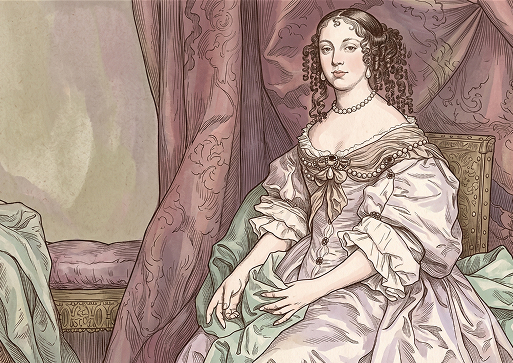
Catherine of Braganza
other
History
On 25 November 1638, a girl named Catarina was born in the Ducal Palace of Vila Viçosa. At that moment, she was merely the daughter of the 8th Duke of Braganza. Two years later, her father left this very palace to be acclaimed King João IV, and the girl from the town became an infanta of Portugal. The gilded childhood between the Palace and the Convent of Chagas next door, where she was educated, did not last: Catherine grew up to be what princesses were in the seventeenth century — a peace treaty with a human face.
And what a treaty. In 1662, she married Charles II of England, and the dowry she brought was one of the greatest in history: two million cruzados, the stronghold of Tangier and the island of Bombay — the seed of the British empire in India. In exchange, Portugal, still at war with Spain, gained the protection of the greatest naval power in the world. The independence her father had proclaimed, the daughter helped secure with her own marriage. Three years later, Spain gave up for good, defeated at Montes Claros, just next door. It is no exaggeration to say it: the girl born in this palace was one of the guarantees that Portugal went on existing.
In London, she paid the price. A Catholic in a Protestant realm, she was never crowned. The court mocked her Portuguese retinue, the pamphlets slandered her, and the greatest pain was intimate: three lost pregnancies, no heir, and a husband who collected mistresses. But Catherine did something remarkable: she refused to be destroyed. She maintained a dignity so unshakeable that Charles II himself, anything but a saint, forbade any disrespect towards her and always refused divorce. And while politics mistreated her, she went on conquering England by another route: its habits. It was she who made tea, which she had drunk since Portugal, fashionable at court — the gesture that would become the most British ritual of all. She brought orange marmalade, forks to the table, the customs of a court that was then among the richest in Europe. The queen England refused to crown ended up shaping English daily life to this day. Tradition further has it that the borough of Queens, in New York, owes her its name.
Widowed in 1685, she eventually returned to Portugal, and the final act was perhaps the most surprising: in the last years of her life, she was regent of the kingdom, governing Portugal in the name of her ailing brother — and governing well, with the firmness of one who had survived twenty years of a hostile court. She died in Lisbon, on the last day of 1705.
Look at the Palace: it was behind those windows that it all began. Vila Viçosa gave Portugal a dynasty, and to the world it gave this woman — who traded her life for her country's independence, lost almost everything along the way, and still left her mark on the teacup of millions of people, every day, for more than three centuries. Some empires are won with armies. Hers was won at five o'clock.
Curated by Storypath


