Montes Claros: the battle that came through Borba
In 1662, Borba saw its captain hanged by the army of Castile. Three years later, that army came back. This time it was not left standing.
Listen to the story
In May 1662, the army of Castile, commanded by Don Juan José of Austria, reached Borba. The town defended itself under its captain-major, Dom Rodrigo da Cunha Ferreira. When it surrendered, the captain and his soldiers were hanged. To Castile, they were not soldiers of an enemy country. They were traitors to their king.
For three days, the army burned and destroyed whatever it found. The town hall went up in flames, and with it the tower clock and all the town’s records. A royal document written shortly afterwards describes the state Borba was left in. There remained no “person who still had a bed”. In the fields, the harvests, the vegetable gardens and the vineyards were lost.
The town did not forget. In 1664, the Marquis of Marialva, general of the Alentejo, appointed a new captain-major for Borba: Francisco Ferreira da Cunha, son of the hanged captain.
In June 1665, Castile returned. This time its commander was the Marquis of Caracena, and Borba did not resist. Caracena occupied the town and used it as a base to besiege Vila Viçosa.
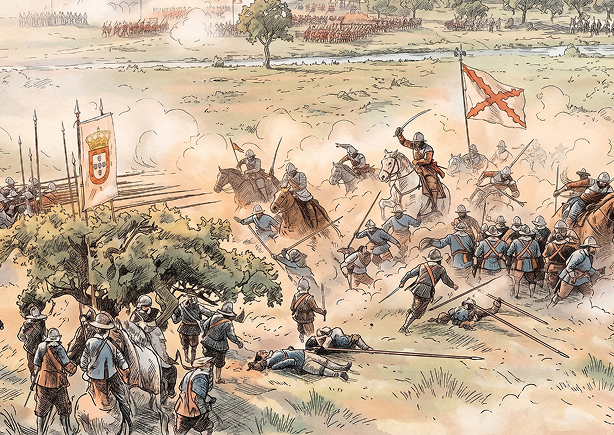
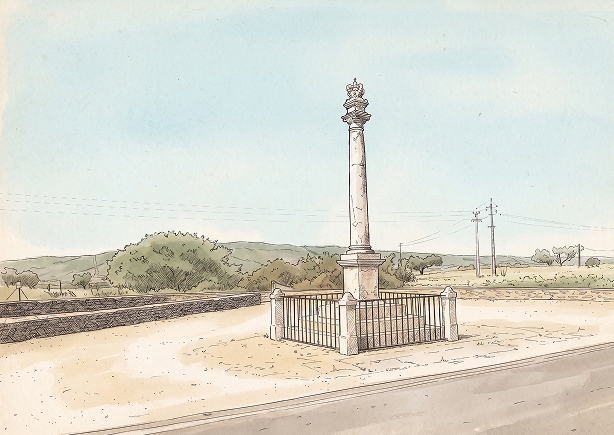
From Estremoz, the Marquis of Marialva set out with the Portuguese army to relieve Vila Viçosa. He camped at a place called Montes Claros, on the road between the two towns, and Caracena marched to meet him. On 17 June 1665, the two armies clashed. The battle lasted seven to eight hours. Among the leaders of the Portuguese cavalry was a man from Borba, Dom Dinis de Melo e Castro, the future Count of Galveias.
By the end of the day, the field of Montes Claros was covered with abandoned weapons. According to the Portuguese chroniclers, Castile had lost four thousand dead and six thousand prisoners, and Portugal seven hundred men. The victory was so unlikely that people spoke of a miracle.
Portugal had been at war for twenty-five years, since 1640, so as never again to belong to Castile. Montes Claros was the last great battle of that war. After it, Spain stopped believing it could reconquer Portugal, and in 1668 it signed the peace and recognised Portuguese independence.
And the date held a coincidence. Sixty-two years earlier, on 17 June 1603, Vila Viçosa filled its streets with triumphal arches and torches to welcome a Castilian bride, Dona Ana de Velasco. Her son was John IV, the king who defied Castile in 1640.
On 17 June, the king’s mother entered Vila Viçosa beneath triumphal arches.
On 17 June, a few kilometres away, Portugal won the battle that secured her son’s kingdom.
© 2026 StoryPath.pt — Made in Alentejo