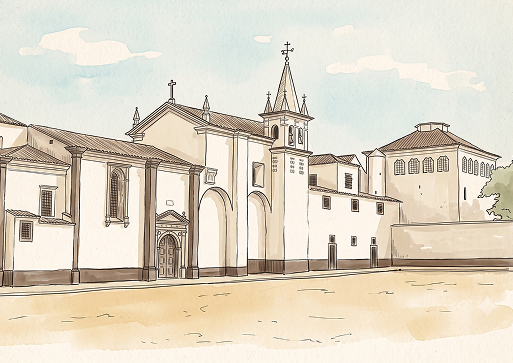
Royal Convent of the Wounds of Christ
church
History
Do the math with me. In 1512, D. Jaime, 4th Duke of Braganza, had his wife killed, convinced of a betrayal no one ever proved. In 1513, he went off to conquer Azemmour to redeem himself. And in 1514, he ordered this convent built, destined to keep, in death, the duchesses of Braganza, and to shelter, in life, women consecrated to God. History does not say it was penance. But it is hard to look at these walls and not see a man trying to make peace with women, one by one, for the rest of eternity.
In 1535 the Poor Clares arrived from Beja, and the convent became the destination for daughters of the kingdom's highest nobility. Many of them had been born of relationships outside marriage: girls whom the society of the time did not know where to place, and whom their fathers handed over to the cloister. Behind these grilles lived generations of women who did not choose to be here. And yet, they made something extraordinary of this house: despite the order's vows of poverty, donations turned Chagas into the richest and most opulent convent in Vila Viçosa, its church covered top to bottom in polychrome tiles, its high altar ablaze with gilded woodcarving.
And they did more: they made sweets. It was in these kitchens that much of Vila Viçosa's confectionery was born, with names that read like a poem: Manjar das Chagas, Toucinho-do-Céu ("bacon from heaven"), Fatias Duquesas ("duchess slices"), Barrigas de Freira ("nuns' bellies"). While the duchesses slept in the pantheon, the nuns whisked egg yolks and sugar. Death and sweetness, under the same roof, for nearly four hundred years.
The end came with a moving slowness. When Portugal abolished the religious orders in 1834, the convent was allowed to continue until the death of its last nun. She held on for seventy years: she only departed in 1905. And here history offers one of its finest rhymes: in 1901, while the last nun was still praying inside, a boy was born in an annex of this convent, where the House of Braganza housed its servants. His name was Bento de Jesus Caraça, son of farm labourers, and he would become one of the greatest Portuguese mathematicians and humanists of the twentieth century. Under the same roof, one world was fading out and another was catching light.
Today, the Royal Convent of Chagas is a pousada, a heritage hotel. The cells where the nuns prayed are rooms where travellers sleep. The duchesses remain in their pantheon, just next door, in silence. And the final irony is perhaps the most beautiful of all: for centuries, this was a building women entered never to leave. Now, anyone can walk in, taste a sweet named after a nun, sleep for a night, and leave in the morning, free. The walls are the same. It is the world that changed.
Curated by Storypath


