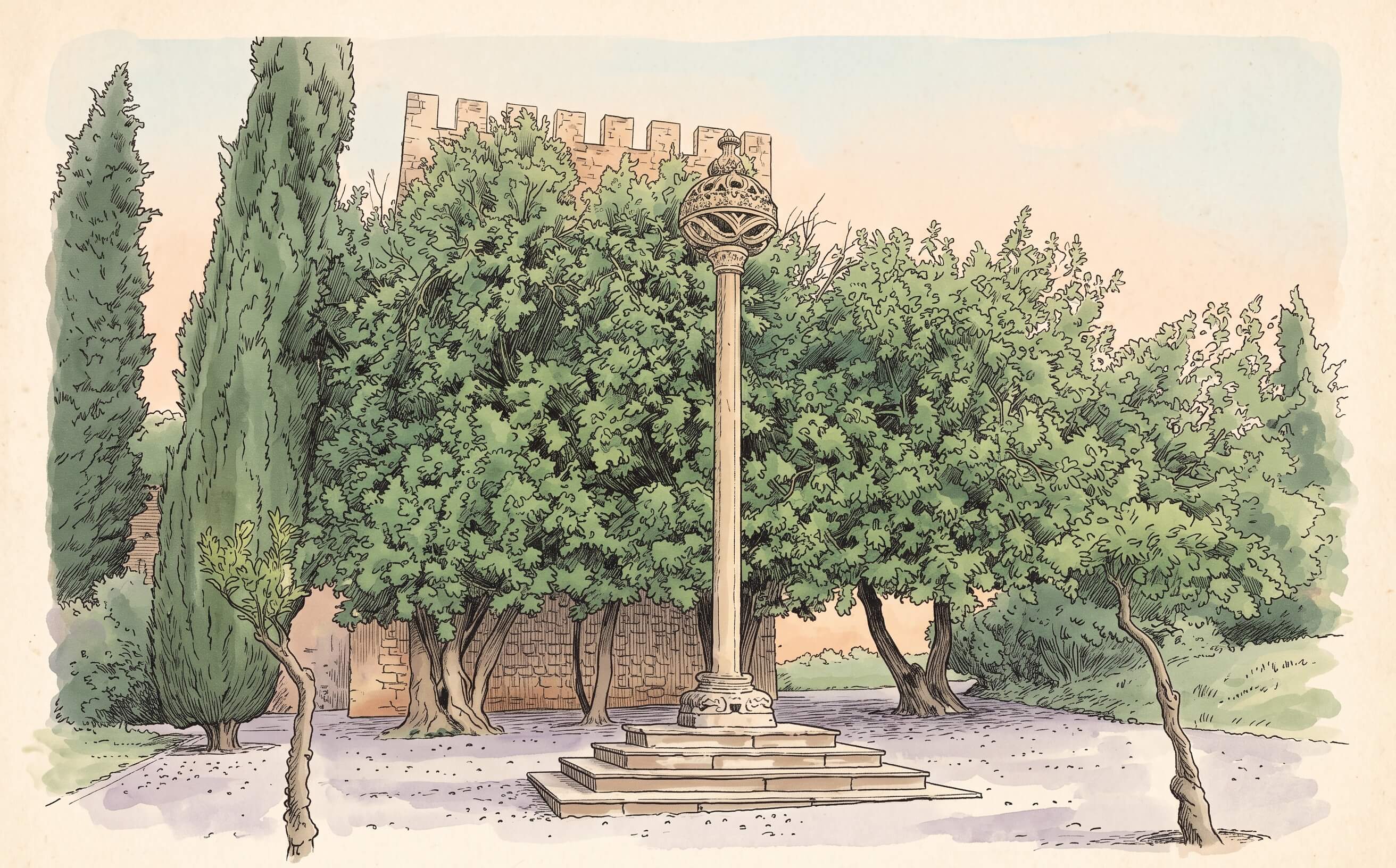
Pillory of Vila Viçosa
monument
History
A pillory is not an ornament. It was a town's identity document: it was raised when the king granted a charter, the document that established rights, duties and a justice of its own. It was here that municipal regulations were posted, and here that the condemned were exposed and punished. A column of stone telling every newcomer: this is no one's wasteland. This is a chartered town, with law.
Vila Viçosa's pillory was born of the New Charter granted to the town by King Manuel I in 1512, renewing the one it had held since 1270. And like everything in this land, it came out different from all the others: eight metres tall, in regional marble, crowned by an enormous pierced stone sphere carved with the filigree of Manueline goldsmithery. A jewel in stone in the middle of the square. It is considered one of the most refined pillories of its style in Portugal, and it became the model the neighbouring towns copied: the pillories of Borba, Alandroal, Monsaraz, Terena and Veiros are all related to it. In this region, justice was measured by Vila Viçosa's standard.
The man who probably commissioned it was the town's overlord, D. Jaime, 4th Duke of Braganza. And this is where the story of this monument takes on a weight no other pillory in the country carries. Because 1512, the year of the charter and of the column of justice, was also the year D. Jaime had his own wife killed, Duchess Leonor, over a suspicion no one ever proved. The crime went without earthly punishment: of the duke, penance was asked, not prison. In the same year, in the same town, justice rose in marble for some and bowed for others. This pillory saw it all: the petty offences exposed on its steps, and the great crime that walked on by.
Notice where it stands: facing the walls and the castle keep. On one side, the fortress of the lords. On the other, the column of the town. For centuries, power and law faced each other like this, across this square. And while the castle keep has plenty of company on the town's postcards today, the pillory remains at its post, elegant and stubborn, reminding us that Vila Viçosa never belonged to the dukes alone. It also belonged, by charter signed by a king, to its people. And the proof stands here, written in marble, for more than five hundred years.
Curated by Storypath


